

By the MJC design team, Orlando. Updated November 2026.
Short answer: Stock and RTA cabinets come in fixed sizes and cost the least. Semi-custom cabinets start from standard boxes but let you change some sizes and finishes. Custom cabinets are built to the exact measurements of your kitchen. In Orlando, RTA fits rentals and tight budgets, while custom pays off when the space or the storage needs are unusual.
What are RTA cabinets?
RTA means ready to assemble. The cabinets ship flat in a box, and you or an installer put the boxes together on site. RTA and stock cabinets come in fixed sizes, usually in 3-inch width steps, and in a short list of door styles and colors. Big-box stores and online sellers carry them, often with no wait.
The appeal is price and speed. The tradeoff is fit. When a wall measures 127 inches and the boxes come in 3-inch steps, the leftover space is closed with filler strips. Corners, soffits and odd ceiling heights are handled with whatever sizes exist in the catalog.
What are semi-custom cabinets?
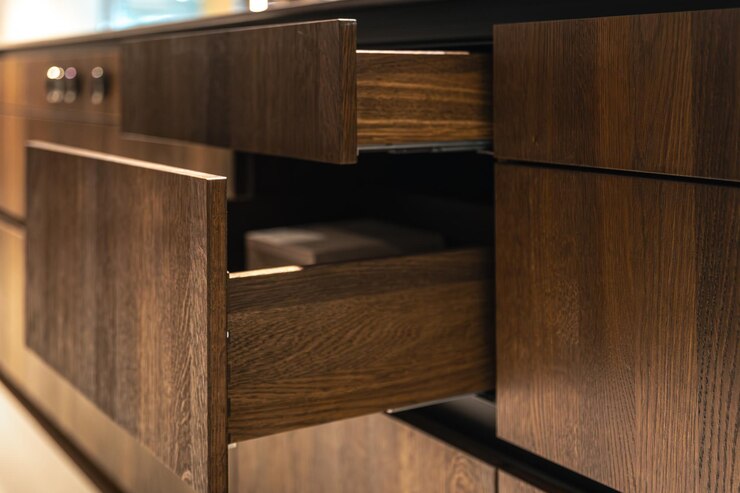
Semi-custom cabinets come from a manufacturer’s catalog, made to order. You start from standard boxes and then change some things within the maker’s limits: depth, height, a wider choice of door styles, more finishes and more storage inserts. They are a step up in choice from stock, and the order goes through the manufacturer’s production schedule.
What are custom cabinets?
Custom cabinets are built for one room. The shop works from your measurements, so each box can be the width, height and depth the space needs. Door style, finish, interior layout and details like a floor-to-ceiling pantry or an island sized to the room are designed for that kitchen, not picked from a catalog. At MJC, custom cabinets are designed in 3D and built to measure in our shop on Forsyth Commerce Rd in Orlando.
How do custom, semi-custom and RTA cabinets compare?
| RTA and stock | Semi-custom | Custom | |
|---|---|---|---|
| Sizes | Fixed, usually in 3-inch steps | Standard sizes with some changes allowed | Built to your exact measurements |
| Door styles and finishes | Short list | Wider catalog | Chosen for your kitchen |
| Who builds and assembles | Factory parts, assembled by you or an installer | Manufacturer, made to order | A cabinet shop, for your project |
| Fit on uneven walls and ceilings | Filler strips and trim | Some adjustment, then fillers | Boxes and scribe built to the room |
| Availability | Often in stock | Ordered from the manufacturer | Built after design approval |
| Upfront price | Lowest | Middle | Highest |
| Where it makes sense | Rentals, tight budgets, utility rooms | Standard layouts that need more choice | Odd spaces, long-term homes, full storage use |
When do RTA or stock cabinets make sense?
There are good reasons to buy the cheaper option, and it is better to say so before anyone pays for a design. RTA or stock cabinets are a sensible choice for:
- A long-term rental or a vacation rental near the parks, where the budget is tight and the finish only needs to be clean and durable
- A house you plan to sell soon, where the kitchen needs a refresh and not a redesign
- A garage, laundry room or utility space where exact fit matters less
- A kitchen whose walls happen to match standard sizes, with few corners or soffits
If one of those describes your project, a lower-cost cabinet line may serve you well. Check box material, hinges and drawer slides closely, because those are the parts that wear first in a humid climate.
Which type handles Florida humidity better?
None of the three is moisture-proof by label alone. What matters is the box material, how the edges and backs are sealed, and the finish on the doors near the sink and dishwasher. Lower-cost RTA lines often use particleboard, which swells once water gets past the edge banding. Semi-custom and custom cabinets let you choose plywood or moisture-resistant panels for the sink base and other wet spots. Whatever you buy, ask what the sink base is made of.
When is custom worth the higher price?
Custom earns its cost when the kitchen does not cooperate with standard sizes or when you will live with it for a long time. Common cases in Central Florida homes:
- Walls and ceilings that are not standard. Angled walls, soffits, tall ceilings and walls that are out of plumb are built around instead of covered with fillers.
- Storage you will actually use. A pantry sized to what you buy, drawers instead of deep base shelves, an island with seating on the side that works for your family.
- Matching rooms. When the kitchen has to match a laundry room, a TV wall or bathroom vanities, one shop can build them all in the same finish.
- Material choice. You decide what the boxes, doors and finishes are made of. Our guide to cabinet materials for Florida humidity covers what holds up near sinks and dishwashers.
- A home you plan to keep. Resale data such as JLC Cost vs Value shows kitchen remodels recover part of their cost when a house sells, not all of it. The stronger reason for custom is how the kitchen works for you while you live there.
How much more does custom cost?
The gap depends on the size of the kitchen and the choices inside it, so any single percentage would be a guess. A better comparison is a quote for the same scope: the same cabinet count, the same countertop and the same installation work. Our guide to custom kitchen cabinet costs in Orlando shows published benchmarks for Orlando and what moves the price. At MJC, complete custom kitchens start at $15,000.
How do you decide for your kitchen?
Start with three questions. Do your walls fit standard sizes, or will fillers eat usable space? How long do you plan to stay in the house? Is the budget fixed at a number that only stock cabinets can meet?
If the answers point to custom, the next step is a measured design. We design your kitchen in 3D at no cost, and our mobile showroom van brings door, finish and granite samples to your home. You can read what happens at a free 3D design visit or see how we build custom kitchen cabinets in Orlando.
Frequently asked questions
Are RTA cabinets worth it?
They can be, for rentals, utility rooms and kitchens with standard dimensions on a tight budget. Look closely at the box material, hinges and drawer slides, since those wear first. In a kitchen with odd walls, the filler strips needed to close gaps can waste usable space.
Can semi-custom cabinets be modified?
Yes, within the manufacturer’s limits. Most semi-custom lines allow changes in depth, height and some widths, plus more door styles and finishes than stock. Anything outside the catalog options usually requires custom work.
Can I mix custom and stock cabinets in one kitchen?
Some homeowners use a custom island or pantry with stock perimeter cabinets. The hard part is matching door style, color and sheen across two sources, so plan the finish before ordering either one.
Do custom cabinets take longer than RTA?
Yes. RTA cabinets are often in stock, while custom cabinets are built after the design is approved. Ask any shop for its production and installation schedule in writing before you sign.
Plan your project with MJC
Get a free 3D design and see door, finish and granite samples at your home. Cabinets are built to measure in our Orlando shop at 5014 Forsyth Commerce Rd. Complete custom kitchens start at $15,000.