

By the MJC design team, Orlando. Updated November 2026.
Short answer: Under cabinet lighting puts light on the counter, where ceiling fixtures leave a shadow from your own head and the wall cabinets. LED strips give an even line of light along the whole counter, LED pucks give pools of light, and both work well when the wiring and fixture position are planned before the cabinets go up.
Why does a kitchen need under-cabinet lighting?
Ceiling lights sit behind you when you stand at the counter, so your own head and the wall cabinets throw a shadow right where you cut, read a recipe or measure coffee. Under-cabinet lighting fixes that by putting the light source above the counter and in front of the backsplash. Designers call it task lighting, and in a kitchen it is the layer that does the most work for the least power.
It also changes how the kitchen looks at night. With the ceiling lights off, a row of lights under the wall cabinets brings out the backsplash and the countertop and works as a soft night light for the whole room.
The energy cost is small. The U.S. Department of Energy consumer guide to energy-efficient lighting says lighting accounts for about 15% of an average home’s electricity use, and that LEDs use up to 90% less energy and last up to 25 times longer than incandescent bulbs.
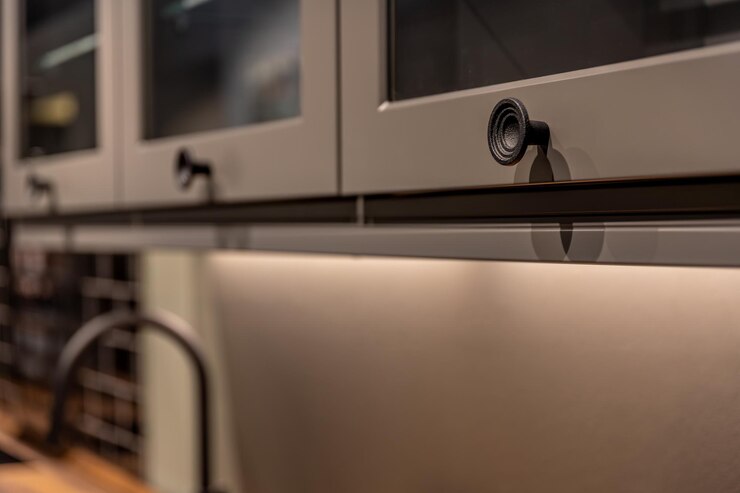
LED strips or puck lights: which should you choose?
Almost every under-cabinet light sold today is LED. The real choice is the shape of the fixture, because it decides whether the counter gets an even wash of light or a row of bright spots.
| Type | Light on the counter | Good for | Watch for |
|---|---|---|---|
| LED strip in an aluminum channel | Even, continuous line | Long runs of counter and polished stone that shows hot spots | Needs a power supply (driver) hidden nearby |
| LED light bar (rigid linear fixture) | Even, with small gaps between bars | Runs that match common cabinet widths, simple replacement later | Bars come in set lengths, so the ends of a run may stay dark |
| LED puck lights | Circles of light with darker areas between | Accent light inside glass cabinets or over a coffee station | Scalloped light on the backsplash, reflections on glossy counters |
| Plug-in or battery fixtures | Varies by product | Existing kitchens where opening walls is not planned | Visible cords or batteries to recharge |
For a new kitchen, strips in a channel are a common choice because they light the counter evenly from end to end. Pucks still have a place inside display cabinets and over open shelving at a bar.
What color temperature should under-cabinet lights be?
Color temperature is measured in Kelvin (K). According to the same DOE guide, lower Kelvin numbers look warmer and more yellow, closer to an incandescent bulb, and higher numbers look cooler and bluer. The Lighting Facts label on the package shows where a product falls on that scale.
Three rules keep the kitchen consistent:
- Match the ceiling lights. Under-cabinet lights that are cooler or warmer than the recessed lights make the counter look like a different room.
- Look at your samples under the light. Warm light brings out wood tones and cream doors. Cooler light keeps white and gray cabinets crisp. Granite can look noticeably different under each.
- Check color accuracy. Packaging often lists a color rendering index (CRI). A higher value shows food and finishes closer to how they look in daylight.
Some strips let you adjust the color or dim the light. A dimmer is worth considering, because the bright setting is for cooking and the low setting is for evenings.
Where should under-cabinet lights be placed?
Placement matters as much as the fixture. A strip mounted at the back, against the wall, washes the backsplash but can leave the front of the counter dim and shows every bump in the tile. A strip mounted toward the front edge of the cabinet lights the work surface, but needs a lip or a light rail molding so the fixture stays hidden from the table. On polished granite, a frosted lens on the channel softens the reflection of each LED.
Beyond the main counters, these spots are worth a look:
- Over the sink, where there is often no wall cabinet. A small fixture inside the valance or a pendant does the same job.
- Inside glass-front cabinets and above open shelves, to show dishes and glassware.
- At the coffee or bar station, often on its own switch.
- In the toe kick, as a low night light.
- Inside a pantry or tall cabinet, with a door switch that turns the light on when the door opens.
Why plan the wiring before the cabinets go up?
Hard-wired under-cabinet lighting needs wires that come out of the wall at the right height behind each run of wall cabinets, a switch where you will reach for it, and a hidden place for the power supply. All of that is simple before the cabinets and backsplash are installed and costly afterward, when tile has to be cut or a cabinet taken down. The wiring is done by a licensed electrician as required.
During design, decide:
- Which runs get light, and whether the island, the shelves or the pantry get their own.
- Where the switch or dimmer goes, and whether the lights share a switch with anything else.
- Where the driver sits, usually inside or above a wall cabinet, with access for service.
- Whether the cabinet bottoms are recessed or get a light rail so the fixtures stay out of sight.
If you are keeping your current cabinets, plug-in or battery fixtures avoid opening walls, at the cost of visible cords or charging.
Do LED under-cabinet lights get hot?
Very little. The DOE guide notes that LEDs are cool to the touch, while incandescent bulbs released 90% of their energy as heat. That matters under a cabinet, a few inches from food, spices and a painted finish. ENERGY STAR also describes LEDs as directional light sources that emit light in a specific direction, which is why a thin strip under a cabinet can light the counter without lighting the ceiling. Near the sink, choose fixtures rated for damp locations.
How does MJC plan cabinets for lighting?
MJC draws the kitchen in 3D before anything is built, so the lighting can be decided with the cabinets instead of after them: which runs get light, whether the cabinet bottoms are recessed, where a light rail hides the fixture and where the driver can sit inside a cabinet. The cabinets are built to measure in the MJC shop in Orlando. Start with our page on custom kitchen cabinets in Orlando. If the lights are part of a larger project, see kitchen remodeling in Orlando, and if your kitchen is tight, our small kitchen ideas show where light and storage help most.
Frequently asked questions
Can I add under cabinet lighting to existing cabinets?
Yes. Plug-in and battery fixtures attach to the bottom of existing cabinets without opening walls. Hard-wired lights in an existing kitchen are possible too, but they may require cutting into the wall or the backsplash, so they are easier to add during a remodel.
How far apart should puck lights be?
It depends on the beam of the fixture and its height above the counter, so follow the spacing guidance for the specific model. Pucks placed too far apart leave dark gaps on the counter, which is why strips are often chosen for long runs.
Do under cabinet lights need their own switch?
Not necessarily, but a separate switch or dimmer lets you use them as a night light without the ceiling lights. Decide this during design, so the switch location is wired before the backsplash goes in.
Will LED strips show dots on a shiny countertop?
They can. Bare LED tape shows each diode as a bright dot on polished stone. An aluminum channel with a frosted diffuser blends the dots into one continuous line.
Plan your project with MJC
Get a free 3D design and see door, finish and granite samples at your home. Cabinets are built to measure in our Orlando shop at 5014 Forsyth Commerce Rd. Complete custom kitchens start at $15,000.